Reapplying to Dental School: How to Find Out Why You Didn't Get In (and Fix It)
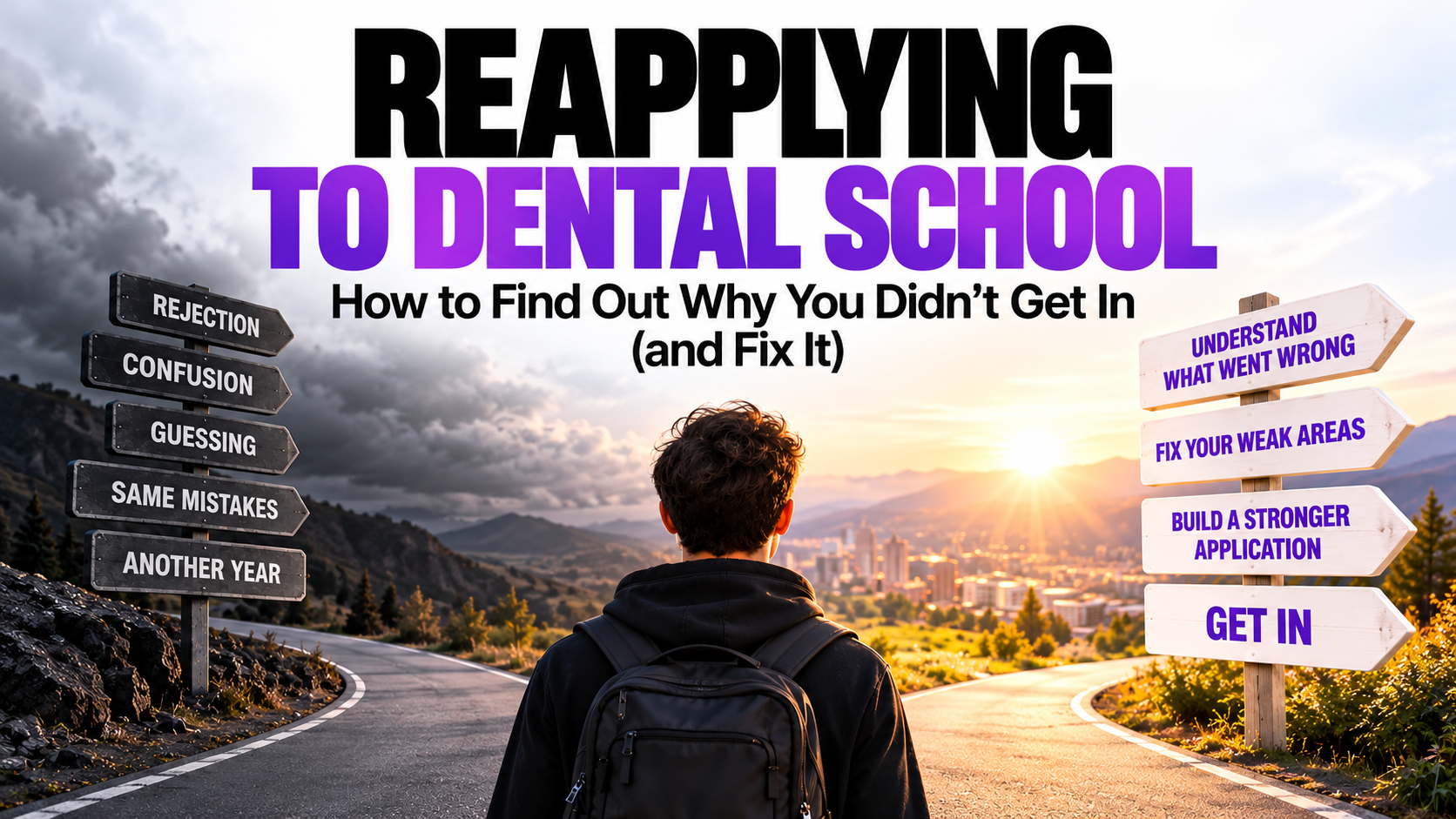
If you didn't get into dental school this cycle, you're probably asking the same question every reapplicant asks: what did I do wrong?
Here's the hard truth. No one is going to tell you. Not the schools, not the rejection email, and usually not the admissions office when you call.
That silence is what makes reapplying to dental school so hard. Most reapplicants guess at what went wrong, fix the wrong thing, and end up with the same result a second time. Another year, another round of application fees, and another stack of rejections.
It doesn't have to go that way. In this guide, you'll learn why schools stay quiet, the two real reasons strong applicants get rejected, the number one mistake reapplicants make, and exactly how to build a reapplication that actually gets you in.
Why Dental Schools Won't Tell You Why You Were Rejected
Most dental schools send a short, generic rejection with no explanation. Some reapplicants take the next step and call the admissions office to ask what they can improve.
And almost every one of them hears the same answer: work on your DAT score.
Here's what most applicants don't realize. That advice gets handed to nearly everyone, including applicants who already have excellent DAT scores. At many schools, the DAT isn't weighted nearly as heavily as it once was. "Improve your DAT" has become the default answer, not a personal diagnosis.
Schools know exactly why you didn't get in
This is the part that surprises people. The admissions committee isn't in the dark. Dental schools evaluate applicants with scoring rubrics, and your rubric scores show exactly where you earned points and where you fell short.
So why not just tell you?
Part of it is volume. Schools receive thousands of applications, and going back through one applicant's rubric line by line to explain every missed point isn't realistic.
The bigger reason is that schools want the authentic you. If every applicant knew exactly what a school's rubric rewarded, many would reshape themselves to fit it, stretching the truth or presenting a version of themselves that isn't real. Admissions committees want to see who you genuinely are, so they keep the details of their rubrics private.
That's a fair goal. But it leaves you, the reapplicant, without the one thing you need most: an accurate diagnosis.
The answer isn't to game a rubric. It's to understand how schools evaluate applicants so you can become a genuinely stronger candidate, and present your real self where it will score well.
The Two Real Reasons Dental School Applicants Get Rejected
Before you change anything about your application, you need to know where you were stopped. Nearly every rejection comes down to one of two problems, and many reapplicants were hit by both.
Reason 1: Your application was filtered out
This is the one that stings the most, because it means you never had a real chance.
Every dental school has eligibility requirements, and some of them are easy to miss. Applications that don't meet them can be screened out before an admissions committee member ever reads your essays. Common examples include:
Expired prerequisites. Some schools only accept prerequisite courses completed within a certain number of years.
Minimum hours. Some schools require a minimum number of shadowing or clinical hours.
Minimum GPA. Some schools won't consider applicants below a set GPA.
Minimum DAT score. Some schools have a floor on the DAT scores they'll accept.
Most applicants who get filtered out have no idea it happened. They believe they were fully eligible, but one detail tripped them up. Every dollar and hour spent on that school's application was wasted.
Reason 2: You didn't score high enough on the rubric
If you were eligible but still didn't receive an interview invite, this is likely your problem.
Your application was reviewed and scored against the school's rubric. You simply didn't earn enough points in the areas that school weighs most heavily. Every school weighs things differently. A profile that scores very well at one school can score poorly at another.
This is why strong stats alone don't guarantee interviews. What matters is how well your full application matches what each specific school rewards.
It's often both
In our experience, most reapplicants were affected by a mix of the two. Some schools on their list filtered them out, and at the rest, they didn't score high enough. Fixing only one problem usually isn't enough.
The Number One Mistake Reapplicants Make
The biggest mistake reapplicants make is simple: they never correctly identify what went wrong.
Everything else follows from that. Without an accurate diagnosis, reapplicants guess. And the most common guess is to do more.
More volunteering. More shadowing. More activities. More hours of whatever they can find. On paper, it feels productive. In practice, it rarely moves the needle.
Why more hours won't fix a scoring problem
Here's something many applicants don't know: a lot of dental schools don't score you on the number of hours you have.
The reason is practical. Hours are difficult to verify accurately. Any applicant can list a large number, and admissions committees know it. So many schools focus on what's harder to fake, like the quality of your experiences, what you learned, and the depth of your commitment.
That means a reapplicant who adds 200 more hours of random activities may score almost exactly the same as the year before. They worked hard, but on the wrong things.
Don't chase the DAT by default
The same trap applies to the "improve your DAT" advice. If your DAT was already strong, spending months studying to retake it could cost you an entire cycle while the real problem goes untouched.
The goal isn't to do more. It's to do the right things, the ones that earn points at the specific schools you're applying to. And you can only know what those are once you've correctly diagnosed why you were rejected.
A Real Reapplicant Story: Great Stats, Zero Acceptances
One student who came to Dental School Guide looked like a near-guaranteed admit on paper.
She had a GPA above 3.9 and a DAT score well above the national average. She had worked as a dental assistant and logged a large number of volunteer and shadowing hours. She applied to 15 dental schools.
She didn't get a single acceptance. She didn't even get an interview.
What went wrong
She'd built her school list around one idea: apply to schools whose accepted students had lower average GPAs and DAT scores than hers. She assumed those schools would be a sure thing.
That assumption is one of the most common traps in dental school admissions. A lower average GPA or DAT doesn't mean a school is easier to get into. It often means that school places more weight on other parts of the application.
When we went through her application, the problem was a little bit of everything. A few schools on her list were never realistic fits. And at most of the others, her application didn't score many points in the sections those schools weighed most heavily. Her strong academics and experience were real, but they weren't what those particular rubrics rewarded most.
What we changed
Dental School Guide worked with her on three things:
Identified where she was losing points on the rubrics of the schools she'd applied to.
Rebuilt her school list around schools where her real strengths would earn more points.
Built a custom plan to raise her score in the areas that mattered most at her new target schools.
The result
In her second cycle, she received a large number of interview invites, earned multiple acceptances, and was admitted to some of her top-choice schools.
Same student. Same strong academics. The difference was an accurate diagnosis and a strategy built around it.
Should You Reapply Right Away or Wait?
The honest answer: it depends on why you were rejected.
If your only problem was your school list, meaning you were filtered out at schools you weren't eligible for, you may be able to reapply in the very next cycle. Fix the list, apply to schools where you're truly eligible and competitive, and you could see a very different result.
But that's rarely the whole story. Most reapplicants need to adjust their school list and raise how they score on the rubrics. Raising your score takes time. You can't build meaningful new experiences overnight.
Give yourself at least four months
If you need to strengthen your application, plan for at least four months between starting new work and submitting your application.
Here's why. Every school is a little different, but many dental schools won't give credit for activities you started within about three months of applying. Anything new you begin right before submitting may not count at all.
A four-month buffer gives your new experiences time to become legitimate parts of your application, not last-minute additions.
The bottom line: don't rush back in with the same application and hope for a different result. But don't assume you have to wait a full year either. Diagnose the real problem first, then give yourself enough runway to fix it.
How to Reapply to Dental School the Right Way
Diagnose before you change anything. Figure out whether you were filtered out, scored too low, or both. Don't rely on the generic "improve your DAT" answer.
Audit your eligibility at every school. Check prerequisite expiration rules, minimum hours, minimum GPA, and minimum DAT for each school on your list.
Rebuild your school list. Choose schools where you're eligible and where your real strengths will score well, not just schools with lower published averages.
Strengthen the right areas. Focus on what your target schools weigh most. Skip adding hours for the sake of hours.
Give yourself enough runway. Plan for at least four months before applying so your new work counts.
Show authentic growth. Your new application should reflect who you've genuinely become, not a version built to impress.
How Dental School Guide Helps Reapplicants
The hardest part of reapplying is the diagnosis, and that's where we come in.
Our School Selection Service helps you build a school list where you're eligible and where your profile will score well, so you're not filtered out before anyone reads your application.
Our Mentorship Program helps you understand how schools evaluate applicants, identify where you're losing points, and build a plan to become a stronger, more competitive candidate.
Frequently Asked Questions
Do dental schools tell you why you were rejected? Usually not. Most send a generic rejection. If you call, the most common answer is to improve your DAT, even for applicants whose DAT is already strong.
Is it harder to get into dental school as a reapplicant? Not necessarily. The key is showing meaningful improvement in the areas that cost you points, not submitting a near-identical application.
Should I retake the DAT before reapplying? Only if your DAT is actually the problem. If your score was already strong, retaking it may not change your outcome and could take time away from what really needs fixing.
Do more shadowing or volunteer hours help? Not automatically. Many schools don't score applicants on the number of hours, because hours are hard to verify. The quality and depth of your experiences matter more.
How long should I wait before reapplying? If you only need to fix your school list, you may be able to reapply right away. If you need to strengthen your application, give yourself at least four months, since many schools won't credit activities started within about three months of applying.
Don't Spend Another Cycle Guessing
Every cycle costs you a year, thousands of dollars in application fees, and a lot of hope. Reapplying with the same blind spots puts all of that at risk again.
You don't have to figure this out alone. Book your free strategy session with Dental School Guide and we'll help you find out why you didn't get in, and build a plan to make sure your next cycle is your last.